
Tel:
+86-15381916109
Email:
Email:
No.26 TianJian Lane, Yinzhou District, Ningbo, Zhejiang, China
Views: 0 Author: Site Editor Publish Time: 2026-05-19 Origin: Site


Standard off-the-shelf fasteners often fail to provide adequate clamping force for non-cylindrical structural components. They simply lack the dimensional accuracy required for specialized mounting. Applying round U-bolts to square beams leads to severe stress concentration. You also risk dangerous component shifting under dynamic loads. Relying on compromised standard sizes forces engineers into costly, improvised on-site secondary machining. This creates safety hazards and delays project timelines.
This article provides engineers, procurement managers, and contractors with a reliable technical framework. We will help you evaluate, specify, and source custom square steel U-bolts effectively. You will learn how to match exact project tolerances and meet strict environmental compliance standards. By the end, you will understand how tailored fastener solutions eliminate field modifications and ensure structural integrity across heavy industrial applications.
Shape Matters: Square U-bolts are engineered specifically for fastening to rectangular surfaces, maximizing contact area and eliminating rotational shifting.
Material-to-Environment Matching: Specifying the right alloy and coating (from Hot-Dip Galvanized to Xylan) prevents premature galling and corrosion in harsh marine, agricultural, or heavy construction environments.
Manufacturing Precision: Modern cold-drawn forming and precise machining reduce structural fatigue and eliminate the need for dangerous on-site modifications.
Procurement Readiness: Submitting a successful RFQ requires exact specifications beyond basic dimensions, including Leg A/Leg B thread lengths, centerline distances, and Non-Destructive Testing (NDT) requirements.
Engineers face unique challenges when clamping flat or rectangular structural beams. Using the wrong fastener geometry jeopardizes the entire assembly. Choosing highly engineered Industrial Customized Square Steel U Bolts provides clear mechanical advantages over standard round alternatives.
Round U-bolts are explicitly designed for piping and cylindrical objects. They have a continuous curve that creates a single, narrow point of contact when applied to flat surfaces. This mismatch focuses intense clamping pressure on a tiny area. Over time, it causes structural crushing or material fatigue. Conversely, square U-bolts feature a precise 90-degree saddle fit. They sit perfectly flush against square structural beams. They distribute clamping pressure evenly across a broad surface area. You avoid localized indentation and protect the integrity of the clamped material.
High-vibration environments introduce continuous dynamic loads. Fasteners in these conditions face immense rotational forces. Round bolts slip against flat surfaces because they lack a stabilizing edge. Square U-bolts solve this problem entirely. Their flat contact surface inherently resists applied torque. They lock the beam securely into place. You eliminate rotational displacement and maintain joint stability even during heavy equipment operation.
Field contractors lose valuable time adapting incorrect fasteners. Standard round bolts often require improvised shims to fit square posts. This practice reduces joint reliability. Square U-bolts provide flush seating straight out of the box. You do not need secondary support materials. This precise fit eliminates excessive torqueing requirements. You drastically reduce installation time. It also mitigates the risk of thread stripping during final assembly.
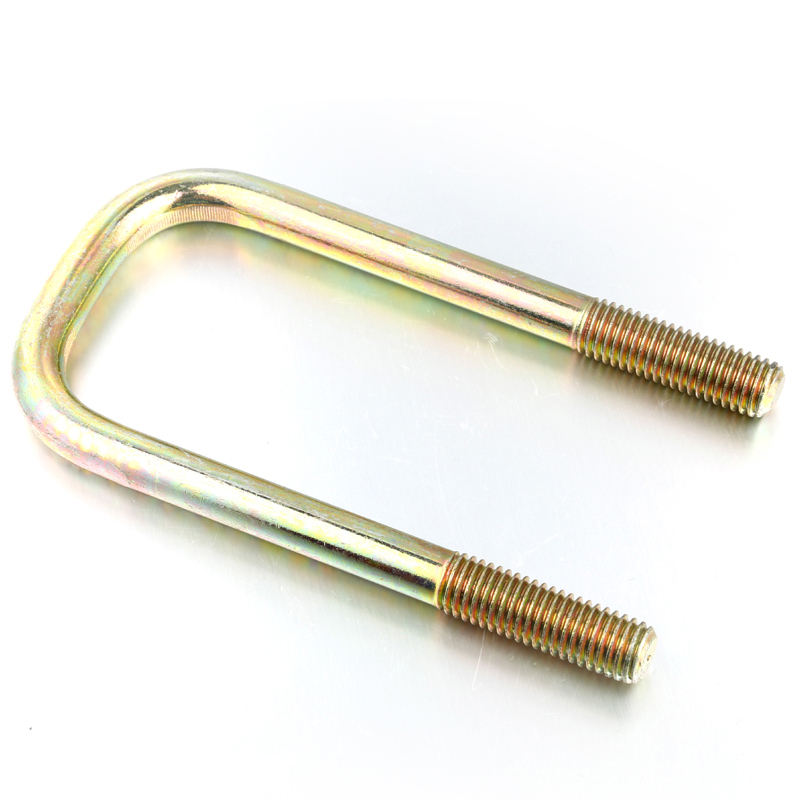
Understanding the anatomy of a fastener helps you specify better components. A reliable U-bolt relies on precision manufacturing at every stage. We must look at its core components and how they are made.
Every U-bolt consists of three functional elements. Each plays a critical role in load distribution and fastening security.
Legs: These are the vertical extensions providing clamping depth. Standard bolts use equal legs. However, custom applications often require unequal lengths (Leg A vs. Leg B). This accommodates asymmetrical mounting needs on uneven structural configurations.
Threads: These ridges handle the primary load transfer. Coarse threads allow for quick assembly and resist cross-threading in dirty environments. Fine threads provide higher tension and better resistance to vibration-induced loosening. You must choose based on your specific operational demands.
Saddle Plates (Optional): These load-dispersing plates sit beneath the nuts. They protect the clamped material from localized indentation. They also add rigidity to the final joint assembly.
Manufacturing techniques directly impact bolt strength. Traditional hot forging heats the metal to extreme temperatures before shaping. It remains a viable method for massive diameters. However, modern cold-drawn wire processing dominates high-performance fastening. Cold drawing pulls steel through a die at room temperature. It aligns the material grain structure. This process yields significantly smoother surface finishes. It also results in much higher tensile strength compared to hot-forged equivalents.
Off-the-shelf bolts often force field workers to make dangerous modifications. They cut excess leg length with grinders or forcefully bend the saddle. These actions destroy the protective coating and weaken the steel. Factory-controlled custom machining solves this entirely. Manufacturers handle heading, welding, punching, and threading under strict quality controls. They ensure precise tolerances. You avoid the massive safety risks of field modifications. Your contractors receive bolts ready for immediate, safe installation.
A fastener is only as reliable as its resistance to environmental decay. Specifying incorrect materials leads to catastrophic joint failure. You must match the steel grade and coating to your exact operational hazards.
Your base material dictates the ultimate load capacity. Carbon steel, such as A36, serves as the standard for general structural support. It offers excellent ductility and weldability. For heavy machinery, you must upgrade. Alloy steels provide the high-tensile strength required for extreme load-bearing applications. They resist shear forces far better than standard carbon variants.
Environmental moisture destroys unprotected steel rapidly. You must select an appropriate defensive barrier.
Coating / Material | Defense Level | Ideal Operational Environment |
|---|---|---|
Plain / Zinc-Plated | Basic barrier against mild moisture. | Climate-controlled facilities, low-moisture indoor industrial applications. |
Hot-Dip Galvanized (HDG) | Thick, rugged zinc barrier. High durability. | Heavy construction, outdoor infrastructure, moderately corrosive environments. |
304/316 Stainless Steel | Maximum intrinsic corrosion resistance. | Harsh marine use, submerged structures, food processing, sanitation applications. |
Standard metallic coatings cannot solve every engineering challenge. Volatile or highly specialized environments require advanced chemistry. Xylan is a widely used fluoropolymer coating. It provides low-friction anti-galling properties. You should specify Xylan for assemblies requiring frequent disassembly and reassembly. For volatile chemical plants, you need non-sparking materials. Brass and bronze U-bolts eliminate the risk of ignition during installation or impact.
Different industries demand vastly different performance metrics from their fasteners. You must evaluate the specific load scenarios before submitting a specification.
Construction sites push structural fasteners to their physical limits. You use square U-bolts for anchoring heavy machinery securely to concrete foundations. They are essential for securing complex scaffolding systems. You also rely on them to fasten structural steel frameworks. In these applications, load-bearing failure is catastrophic. You must specify high-tensile alloy steels and robust HDG coatings to handle massive static loads and outdoor exposure.
Farming machinery operates in uniquely brutal conditions. You use heavy-duty U-bolts to secure tractor cross-members. They also fasten planter toolbars and heavy attachments. Agricultural equipment constantly navigates uneven terrain. This generates continuous shock and intense vibration. Standard fasteners loosen or shear under these dynamic forces. You must specify precision-rolled threads and high-strength alloys to withstand this relentless abuse.
Water-bound infrastructure faces a dual threat. Fasteners must handle high load capacities while battling extreme salt-water corrosion. You use square U-bolts for boat trailer brackets. They reinforce critical dock components and retaining walls. Regular steel fails within months in these environments. You must strictly specify 316 Stainless Steel or heavily galvanized custom bolts. Government projects also mandate strict material traceability and compliance certifications for all marine fasteners.
Vague specifications lead to manufacturing errors and project delays. You must provide exact, unambiguous data when requesting a quote. Use the following structured checklist to prepare a flawless RFQ.
Never rely on generic descriptions like "medium size." Define the exact measurements required to prevent miscommunications.
Thread Diameter and Pitch: Specify the exact rod thickness. State whether you need coarse (UNC) or fine (UNF) thread pitch.
Inside Width: Provide the exact centerline distance. This determines how snugly the bolt fits over your square beam.
Inside Length: Measure the total depth of the U-shape. Account for the beam thickness, mounting plate, washers, and nut engagement.
Thread Length: Specify exactly how far up the leg the threads must go. If your mounting surface is asymmetrical, state clearly if Leg A and Leg B require different thread lengths.
You cannot compromise on quality assurance. Always demand proof of capability from a manufacturer before finalizing an order.
Material Certifications: Require official documentation proving the steel meets specific ASTM or ISO standards.
Non-Destructive Testing (NDT): Ask about their internal testing capabilities. Magnetic particle or ultrasonic testing ensures no internal micro-cracks exist in the bent corners.
Clear Communication: Evaluate their responsiveness. Demand transparent lead times. Ask if they offer rapid prototyping capabilities for complex, high-volume orders.
Custom square steel U-bolts are far more than basic commodities. They are engineered fastening solutions designed to secure critical infrastructure. Using precise, custom-manufactured bolts prevents catastrophic equipment failure. They eliminate on-site installation friction, protect worker safety, and reduce long-term maintenance needs. You ensure the structural integrity of your assembly by matching exact tolerances to your specific operational environment.
Audit your current fastening challenges immediately. Stop relying on inadequate off-the-shelf round bolts for square applications. Transition your procurement strategy to a custom-spec approach. Gather your dimensional drawings and consult with a dedicated engineering support team to draft an exact, precise RFQ today.
A: Yes, custom manufacturers routinely produce "Square Bend with Unequal Legs" to accommodate asymmetrical mounting surfaces or uneven structural configurations. You simply need to specify the exact dimensions for Leg A and Leg B in your RFQ.
A: Rolled threads are formed by pressing the steel, which maintains the grain structure and typically offers higher fatigue resistance. Cut threads remove material to form the ridges, which can disrupt the grain but is sometimes necessary for specific custom diameters.
A: Torque specifications depend heavily on the material grade, thread pitch, and whether the U-bolt has a specific anti-friction coating (like Xylan or Zinc), which can alter the friction coefficient. Always refer to the manufacturer's engineering data for your specific batch.