
Tel:
+86-15381916109
Email:
Email:
No.26 TianJian Lane, Yinzhou District, Ningbo, Zhejiang, China
Views: 0 Author: Site Editor Publish Time: 2026-05-25 Origin: Site


Procuring articulated fastening components requires balancing dynamic load requirements against severe environmental factors. You must get this balance exactly right. Specifying the wrong eye bolt often leads to premature wear, fixture failure, or safety violations. Misunderstanding the structural limits of DIN standards amplifies these risks. We built this guide to help engineering and procurement teams navigate these exact challenges. Our framework provides an evidence-based approach for evaluating, specifying, and sourcing your components. You will learn about critical material comparisons and safety limits. We also dive into standard equivalency across global markets. This ensures you select the optimal DIN 444 Stainless Steel Eye Bolts for your specific application. You will gain actionable insights regarding installation geometry. These insights prevent catastrophic mechanical failures.
Core Functionality: DIN 444 eye bolts (often utilized as swing bolts) are engineered with an articulated head design, allowing for dynamic angular compensation (up to ±30°) ideal for jigs, fixtures, and vibrating machinery.
Material Standards: Austenitic stainless steel (A2/A4) provides essential corrosion resistance for harsh environments, often finished with matte shot-blasting.
Standard Equivalency: DIN 444 remains a global benchmark, functionally cross-referenced with UNI 6058, ČSN 021167, and PN 82425 standards.
Safety Imperative: Strict installation protocols apply—loads must align with the eye plane, washers cannot exceed one thread pitch in thickness, and compromised bolts must be physically destroyed, never repaired.
Let's create a clear structural definition. The baseline morphology features a loop or ring head. This head transitions smoothly into a threaded shank. Engineers design a minimum 5-millimeter radius at this critical transition zone. This specific geometry minimizes dangerous stress concentrations. The industry classifies these components primarily as "swing bolts." They see heavy use in industrial jigs. Tie-downs and precision fixtures rely heavily on them. They provide flexible anchoring points. You can adjust them quickly during complex assembly processes.
Manufacturing these fasteners demands high precision. Premium manufacturers rely heavily on hot-forging techniques. Hot forging preserves internal grain structure integrity. The metal flows along the shape of the part. This makes the final fastener much stronger than machined alternatives. After the initial forging process, facilities utilize CNC turning. This subsequent step ensures exact thread precision. Threads generally comply strictly to DIN 76 Part 1 rules. These rules dictate the acceptable tolerances for incomplete thread runouts. Precision here guarantees smooth mating action.
Why do DIN standards persist today? We see many industrial sectors shifting toward broader ISO frameworks. However, the DIN standard remains firmly entrenched. It dominates modern industrial supply chains globally. It acts as a non-obsolete benchmark. Many specialized parts simply lack direct ISO counterparts. Engineers trust the established mechanical thresholds. International sourcing requires knowing equivalent regional standards. This knowledge prevents supply chain bottlenecks.
International Standard Equivalency Chart | ||
Region / Standard Body | Standard Designation | Functional Match |
|---|---|---|
Germany (DIN) | DIN 444 | Primary Benchmark |
Italy (UNI) | UNI 6058 | Direct Equivalent |
Czech Republic (ČSN) | ČSN 021167 | Direct Equivalent |
Poland (PN) | PN 82425 | Direct Equivalent |
You must leverage these cross-references during procurement. They aid international sourcing efforts immensely. If a supplier lacks DIN stock, ask for UNI 6058. This flexibility keeps production lines moving seamlessly.
Austenitic stainless steel dominates the global fastener market. It accounts for over 90% of commercial eye bolt sourcing. Specialized sectors demand this specific metallurgy constantly. You find these fasteners everywhere in food processing facilities. Chemical plants and maritime operations rely heavily on them. The reason remains completely straightforward. Austenitic structures offer exceptional corrosion resistance. They do not require secondary protective coatings. They maintain their integrity across decades of continuous exposure.
You must evaluate two primary grades carefully:
A2 Grade (AISI 304/303NI): This serves as the essential baseline. It works perfectly for general outdoor use. It handles washdown environments extremely well. Manufacturers often apply a matte shot-blasted finish. This specific surface treatment prevents particulate buildup effectively. Food grade facilities demand this finish for sanitary reasons.
A4 Grade (AISI 316/316L): We mandate this premium grade for extreme conditions. It excels in high-chloride areas. Saline coastal environments require A4 steel. Aggressive chemical processing plants also demand it. The added molybdenum prevents dangerous pitting corrosion.
You also need to understand mechanical strength classes. We typically see standard property classes like 50, 70, and 80. These specific numbers dictate tensile strength requirements. A class 70 bolt provides a tensile strength of 700 N/mm². A class 80 yields 800 N/mm². This directly dictates material viability. You must match the class to your specific load-bearing fixtures. A heavy vibrating machine requires a higher property class. Understanding these variables ensures safe operation. Using properly rated DIN 444 Stainless Steel Eye Bolts prevents unexpected structural shearing.
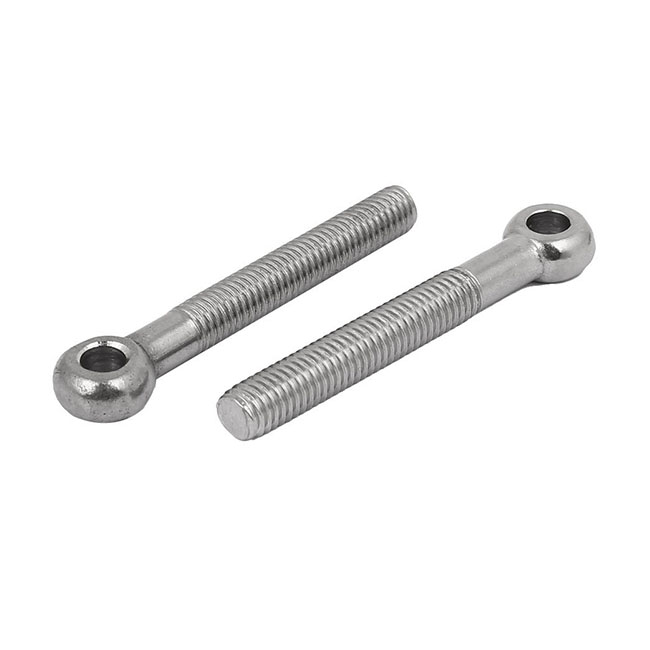
We must address a critical functional dichotomy. Many junior engineers confuse these two distinct fasteners. They look somewhat similar visually. However, they serve completely different engineering purposes. We use DIN 444 exclusively for dynamic applications. Conversely, DIN 580 focuses strictly on static vertical lifting. You risk catastrophic failures by swapping them blindly.
Let's examine load and angle compensation closely. The hinged, articulated design of the swing bolt offers unique flexibility. It accommodates a ±30° axial swing safely. This dynamic angular compensation proves incredibly valuable. It makes the component superior for hydraulic linkages. We also specify them heavily for track shock absorbers. Vibrating mechanical assemblies rely on this swing action. The joint absorbs slight misalignments without snapping the shank.
DIN 580 behaves very differently under stress. It suffers severe load capacity degradation under non-vertical forces. For example, a 30° inclined load causes an approximate 13% loss in lifting capacity. A 45° angle drops capacity by nearly 25%. The solid ring design cannot absorb the lateral torque. The stress concentrates dangerously at the shank base.
Metallurgy and wear patterns also diverge sharply. DIN 444 involves constant moving parts. The hinge components experience continuous friction. Therefore, they often require advanced hardening treatments. Manufacturers target HRC 38-42 hardness levels specifically. This mitigates friction-induced wear significantly. DIN 580 ignores this requirement entirely. It emphasizes a static, single-piece heavy forging instead. It never expects rotational wear at the eyelet.
Here is a detailed performance comparison:
Operational Comparison: Swing Bolts vs. Lifting Bolts | ||
Engineering Variable | DIN 444 (Swing Bolt) | DIN 580 (Lifting Eye Bolt) |
|---|---|---|
Primary Function | Dynamic angle compensation | Static vertical lifting |
Axial Swing Allowed | Up to ±30° movement | Vertical only (degrades rapidly) |
Metallurgical Focus | Hardened hinge points (HRC 38-42) | Single-piece heavy forging |
Vibration Tolerance | Excellent (absorbs shock) | Poor (risk of loosening/snapping) |
Joint Assembly | Mates via bearing pins | Rigid fixed attachment |
Safety protocols remain absolutely non-negotiable. You must enforce strict installation geometry across your facility. Loads must strictly align with the plane of the eye. We strongly warn against non-aligned angular loading. This rule applies intensely to plain DIN 444 variants. If your setup requires angular loads, change your hardware. Angular loads strictly require shoulder variants. The shoulder distributes lateral forces across the mounting surface.
Tolerance restrictions dictate long-term structural integrity. You might use shoulder variations alongside washers. If you do, follow a strict engineering rule. The washer thickness must never exceed one single thread pitch. Furthermore, the bolt shoulder must sit entirely flush against the mating surface. Failing this flush-mount rule drastically reduces the rated load capacity. The shank will bend under lateral stress.
Inspection protocols demand absolute clarity and rigid enforcement:
No Painting Allowed: Painting eye bolts is strictly prohibited globally. Paint easily conceals microscopic stress fractures. It also hides early physical wear indicators. Inspectors must see the bare metal.
Mandatory Destruction: Bolts deform under heavy stress eventually. When this happens, you must physically destroy the unit. Crush or cut the metal ring completely. This action prevents accidental, highly dangerous reuse by uninformed staff.
Do Not Repair: Never attempt to straighten a bent threaded shank. Metallurgical fatigue cannot be reversed by brute force. Heating and bending destroys the grain structure.
Dynamic applications demand ongoing maintenance realities. Articulated joints experience continuous metallic friction. You must address this friction proactively. Facility managers must mandate regreasing these pivot points every six months. This basic lubrication routine prevents severe galling. Galling occurs when stainless steel threads lock together destructively. We recommend adding this task to your master facility maintenance schedule. Proper maintenance extends component lifespan dramatically.
Sourcing industrial components goes beyond buying cheap raw parts. You need a comprehensive vendor evaluation strategy. Evaluate suppliers based on their ability to provide integrated systems. Avoid vendors selling isolated, disconnected components. A holistic approach saves assembly time later.
We highly recommend sourcing standard metric sizes simultaneously. Procure M6 through M12 sizes alongside their compatible hardware. For instance, ask vendors for exact-match bearing pins. GN 732.1 style shoulder screws make excellent system companions. This integrated procurement ensures optimal mechanical fit. It drastically reduces joint friction on the assembly line.
Next, assess the customization capabilities of your shortlisted manufacturers. Standard catalog specifications do not fit every project perfectly. Look for manufacturers offering distinct, proven modifications.
Key customization benchmarks to evaluate include:
Custom thread lengths designed for specialized mechanical linkages.
Specific coating thicknesses applied over the base metal.
Dacromet coatings applied precisely between 8-12μm for hybrid steel setups.
Specialized CNC modifications meeting verified minimum order quantities (MOQs).
Rapid prototyping services for custom articulated joints.
Request official material test reports (MTRs) before finalizing any bulk purchase. This crucial documentation verifies the exact steel grades provided. It also confirms strict RoHS compliance. Vendors refusing to supply MTRs represent a major supply chain risk. Choose partners offering complete metallurgical transparency. Ask about their internal quality assurance procedures. Request details regarding their post-forging inspection routines. Reputable suppliers welcome these rigorous sourcing questions.
Let's summarize this technical decision matrix clearly. DIN 444 stainless steel eye bolts act as vital precision components. They are uniquely optimized for dynamic environments. They withstand harsh elements easily due to their austenitic metallurgy. Their articulated design perfectly suits complex fixturing needs.
Your next operational steps include:
Audit your current mechanical load paths immediately.
Consult your engineering CAD or specification sheets directly. Verify exact accessory compatibility before ordering new batches.
Request official material test reports (MTRs) from your shortlisted suppliers.
Confirm proper steel grade certifications and full global RoHS compliance.
Following these steps ensures safe, highly durable mechanical assemblies.
A: They are primarily designed as swing bolts for fixtures and tie-downs. Overhead lifting should generally utilize strictly rated lifting hardware. Engineers recommend DIN 580 or swivel hoist rings for vertical loads. The only exception is if specific shoulder-type DIN 444 variants are explicitly certified by the manufacturer for overhead load limits.
A: These classifications denote specific grade and style variations. Type B typically relates to specific dimensional or surface finish tolerances. It often indicates variations in incomplete thread allowances along the shank. Always verify standard engineering drawings to ensure the selected type meets your specific joint requirements.
A: Single-point fixed eye bolts present major risks under rotational stress. A rotating load can cause the fixed thread to accidentally unscrew. It also introduces dangerous shock-load variables to the shank. Swivel hoist rings rotate freely, effectively eliminating these critical mechanical safety hazards.