
Tel:
+86-15381916109
Email:
Email:
No.26 TianJian Lane, Yinzhou District, Ningbo, Zhejiang, China
Views: 0 Author: Site Editor Publish Time: 2025-08-21 Origin: Site


You use hex socket cap head bolts when you need strong, reliable fasteners for demanding jobs. People often call these socket cap screws, socket head cap screws, Allen head screws, or even hex screws. You notice that socket head cap screws feature a cylindrical head with a hexagonal recess, designed for use with an Allen wrench. Socket cap screws come in different thread types, lengths, and diameters. You often find them made from steel, stainless steel, or alloy steel. Socket head cap screws meet strict standards for strength and durability. When you choose socket cap screws or cap head bolts, knowing the exact technical details helps you pick the right socket head cap screws for your project.
Hex socket cap head bolts have a small round head. There is a hexagonal hole in the head. You can tighten them with an Allen wrench. This makes the bolt strong and tight.
These bolts come in many sizes. They have different thread types. They are made from steel or stainless steel. They follow strict rules for strength. They are built to last a long time.
The design fits into tight spaces. It gives a strong grip. This makes the bolts good for machines and cars. They are also used in aerospace and other tough jobs.
You need to pick the right bolt for your project. Match the size, material, thread type, and coating. This helps the bolt work well in your environment.
Install bolts the right way and check them often. Use the correct tools and torque. This keeps bolts safe and helps them last longer.

Hex socket cap head bolts have many names. People call them socket cap screws, socket head cap screws, allen key bolts, or hex socket cap screws. These bolts have a round head with a hex hole. You use an Allen wrench or hex key to turn them. Rules like ASME B18.3 and ISO 4762 tell us how these bolts should look. They say what size the head, body, and hex socket should be. The rules also say what materials you can use, like alloy steel. They explain how the bolts should be heat treated. These bolts are very strong and hard. That makes them good for jobs that need careful assembly or a neat look. ASTM A193 Grade B16 is another rule that covers the size and fit. This means you can trust these bolts to work well in your projects.
Socket head cap screws have a special design. The head is small and round. It sits flat or below the surface in a counterbored hole. The hex socket lets you use an Allen wrench or hex key. This helps you get a good grip and stops the bolt from stripping. The table below shows the main features:
Feature | Description |
|---|---|
Head Shape | Small round head, fits flat in counterbored holes |
Drive Type | Hex socket (Allen or hex key), lets you use exact force |
Additional Note | Small design, good for tight spaces and smooth finishes |
You see socket cap screws in machines, cars, and precise equipment. The small head and inside drive make them great for tight spots or smooth surfaces.
Socket head cap screws are not the same as regular hex bolts. The biggest difference is the head and how you turn them. Socket cap screws have a hex hole inside. This lets you use more force without stripping the bolt. The table below compares them:
Aspect | Socket Head Cap Screws (Allen Key Bolts) | Standard Hex Bolts |
|---|---|---|
Torque Transmission | Inside hex hole lets you use more force | Can’t use as much force |
Head Design Strength | Stronger, less likely to strip | Easier to strip with too much force |
Installation Control | Easier to control and place | Harder to control, can get damaged |
Application Suitability | Good for strong, precise jobs | Good for building and general use |
Bearing Surface (Washer Face) | Has washer face, protects surfaces | No washer face |
End Shape | End is angled | End is flat |
Tolerances | Made for exact fit | Made for rough fit |
You use socket head cap screws when you need a tight fit and strong hold. They work well in machines or places with lots of stress. Regular hex bolts are better for building things where you just need strength. Socket cap screws also fit better in parts made for them. You find them in engines, CNC machines, and even planes and cars, where you need things to work perfectly.

It is important to know the size of hex socket cap head bolts before using them. These bolts come in metric and inch sizes. The iso 4762 standard lists metric sizes from M2 to M42. The din 912 standard also covers these metric sizes. Inch sizes follow the ASME B18.3 standard, from 1/8 inch to 1 inch. You often see sizes like M6, M8, and M10 in machines.
Standard | Size Range (Metric) | Size Range (Inch) |
|---|---|---|
iso 4762 | M2 - M42 | - |
din 912 | M2 - M42 | - |
ASME B18.3 | - | 1/8" - 1" |
Each bolt size has its own head diameter, thread pitch, and length. These details help you pick the right bolt for your project. Bolts can have full or partial threading. Full threading gives more grip and higher torque. Partial threading, like in socket shoulder screws, helps line up parts or lets them move. You use partial threading when you need parts to move or line up just right.
Tip: Always check the iso 4762 or din 912 standard for the exact size before buying high tensile socket cap screws.
You must match the bolt’s thread type to the hole for a tight fit. Hex socket cap head bolts use different thread types. The most common are UNC, UNF, coarse thread, and fine thread. Metric bolts follow din 912 and iso 4762. Inch bolts follow ASME B18.3.
Thread Type | Standards Referenced | Size Range (Metric) | Size Range (Inch) |
|---|---|---|---|
UNC | din 912, ASME B18.3 | M2 - M64 | 1/4" - 3" |
UNF | din 912, ASME B18.3 | M2 - M64 | 1/4" - 3" |
Fine Thread | din 912, ASME B18.3 | M2 - M64 | 1/4" - 3" |
Coarse Thread | din 912, ASME B18.3 | M2 - M64 | 1/4" - 3" |
Coarse threads are good for general use and holding things together. Fine threads are better for careful clamping and high torque jobs. Always check the thread type before you start. This helps you avoid mistakes and makes sure the bolt holds tight.
You want your socket cap screws to be strong and last a long time. Most hex socket cap head bolts are made from steel, like Class 8.8 steel. This steel has a minimum strength of 800 MPa. Some bolts use alloy steel, stainless steel, or special materials like Monel. Alloy steel bolts are very strong and fit in small spaces. Stainless steel bolts do not rust and work well in wet places. Monel bolts are great for seawater and acids.
Bolts can have different finishes to stop rust. Common finishes are zinc coating, chromate plating, black oxide, nickel plate, and chrome plate. These finishes help protect the bolts and make them last longer.
Property Class | Hardness (HRC) | Tensile Strength (MPa) | Yield Strength (MPa) | Elongation (%) |
|---|---|---|---|---|
12.9 | 39-44 | 1220 minimum | 1100 minimum | 8 minimum |
High tensile socket cap screws made to din 912 and iso 4762 are very strong. They do not stretch, break, or wear out easily. The bolts are heat treated by quenching in oil and tempering at high heat. This makes them tough and good for clamping and torque.
Note: Pick the right material and finish for where you use the bolt. Stainless steel is best if you need to stop rust. Alloy steel is best for the strongest hold.
You need to make sure your hex socket cap head bolts meet world standards. The main standards are iso 4762 and din 912 for metric bolts, and ASME B18.3 for inch bolts. These rules tell you the right size, thread, material, and strength. ASTM F837-20 is for stainless steel socket head cap screws. ASTM A574-21 is for alloy steel socket head cap screws. ISO 9001:2015 makes sure companies use good quality systems.
Standard Organization | Standard Code | Scope and Relevance |
|---|---|---|
ASME | B18.3 | Socket cap screws, inch series, dimensional data |
ASTM | F837-20 | Stainless steel socket head cap screws |
ASTM | A574-21 | Alloy steel socket head cap screws |
ISO | 4762 | Metric hex socket cap head bolts |
DIN | 912 | Metric socket cap screws, harmonized with ISO |
ISO | 9001:2015 | Quality management system |
Always check the standards before you buy socket cap screws. Standards like din 912 and iso 4762 make sure your bolts fit and work well. These rules also set how much force and grip the bolts need. You get bolts you can trust for machines and other important jobs.
Reminder: Using standards like din 912 and iso 4762 helps you avoid problems. Always use bolts that meet these rules for safety and good results.
Socket head cap screws give you many good things. They are very strong because they use alloy steel or stainless steel. You can use smaller socket cap screws and still trust them to work well. The hexagonal recess lets you use more force to tighten them. This means you do not need as many screws, so you save money. The small head fits in tight spaces, which is great for small areas. It is easy to put these screws in because the hex socket stops slipping. You can use hand tools or power tools without problems. These screws have special coatings like zinc, chromate, or black oxide. The coatings help them last longer in tough places. Socket cap screws have tight tolerances, so they hold things together really well. You can find many types and materials, so you can pick the best one for your job.
Very strong from alloy or stainless steel
Small head fits in tight spaces
Hex socket lets you use more force
You need fewer screws, so you save money
Easy to install and less likely to slip
Special coatings help stop rust
Tight fit for strong clamping
Many types and materials for different jobs
Tip: Pick socket cap screws when you need strong fasteners in small spaces. The small head and tight fit make them great for important jobs.
Socket head cap screws are used in many industries. You see them in cars where strength and rust protection are important. People in aerospace use them for equipment that needs to be tight and strong. Oil and gas companies use these screws for machines in rough places. Energy companies use them for strong fasteners in their equipment. Factories use socket cap screws to hold machines and tools together.
Industry/Field | Typical Equipment or Assembly Uses |
|---|---|
Automotive | Assemblies needing high strength and corrosion resistance |
Aerospace | Precision equipment needing higher torque and clamping force |
Oil and Gas | Equipment exposed to corrosion and heat |
Energy | Durable, high-strength fasteners for assemblies |
Machinery & Equipment | Secure connections in machinery and industrial equipment |
Tool and Die | Fixtures needing high strength and precision clamping |
Structural Assembly | Modular constructions and structural assemblies |
Industrial Settings | Vibration-proof, pressure-reducing, or captive panel screws |
Manufacturing | Machinery assembly and industrial applications |
Electronics | Precision instruments and assemblies in space-constrained areas |
You use socket cap screws in tool and die fixtures, machines, and building frames. These screws hold things tight and let you use more force. They are important for jobs that need to be strong, safe, and last a long time.
You want to pick the right hex socket cap head bolts for your project. Start by checking the size and length. Make sure the bolt fits the thickness of your materials and any washers or nuts you use. Next, look at the material. Stainless steel works best for outdoor or wet places because it resists rust. Carbon steel fits general jobs, while alloy steel gives you extra strength for heavy-duty tasks. Match the thread type to your needs. Coarse threads work for most jobs, but fine threads help with vibration or precise clamping. Always choose the right grade for your load. Higher grades handle more stress. Pick a coating like zinc or galvanizing if you need protection from corrosion.
Tip: Always check if the bolts meet standards like ASTM or ASME. These rules make sure your bolts are safe and strong for important jobs.
Size and length fit your materials
Material matches your environment
Thread type suits your application
Grade handles your load
Coating protects against rust
Industry standards help you choose bolts for safety-critical uses. ASTM grades like B7, B16, B8, and B8M set rules for strength and corrosion resistance. These standards make sure your bolts work in high-pressure or harsh places. Stainless steel grades 304 and 316 give you extra protection in tough environments. Alloy steels offer high strength and respond well to heat treatment.
Proper installation keeps your bolts secure and safe. Use the right Allen wrench or hex key for your bolts. This stops slipping and makes tightening easy. Add washers to spread the load and keep bolts tight, especially if your project faces vibration. Dog point screws help you line up parts for accurate assembly. Lockwire screws prevent loosening in high-vibration areas.
Check the recommended torque before tightening. Use a torque wrench to avoid over-tightening or under-tightening. Here is a table with sample torque values for common bolt sizes:
Bolt Size | Grade 2 (lb-ft) | Grade 5 (lb-ft) | Grade 8 (lb-ft) |
|---|---|---|---|
1/4" | 4 | 6 | 10 |
1/2" | 37 | 60 | 90 |
1" | 210 | 320 | 470 |
Metric bolts also have specific torque values. For example, an M6 bolt in class 10.9 needs about 9.15 Nm. An M16 bolt in class 12.9 needs 225 Nm.
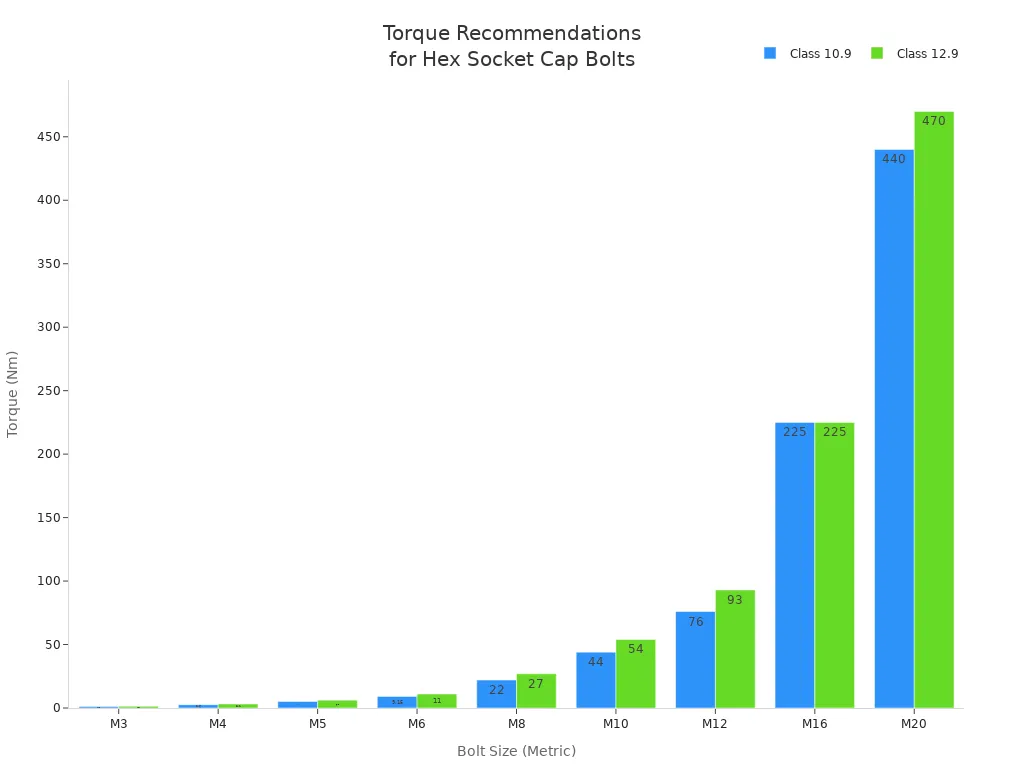
Note: For bolts smaller than 1/4", tighten one screw to its limit, then back off about 30%. This helps avoid damage.
You keep your bolts working well by following good maintenance steps. Pick bolts with the right material and finish for your environment. Always use the correct torque and tightening sequence. Use torque-limiting tools to prevent damage. Clean bolts often to remove dirt and moisture. Apply protective coatings or corrosion inhibitors if needed. Inspect bolts regularly, especially in places with vibration. Replace any bolts that show wear or damage.
Choose materials and finishes for your environment
Follow torque specs with calibrated tools
Clean bolts to prevent rust
Apply coatings or inhibitors
Inspect and replace as needed
Reminder: In high-vibration areas, check bolts often and replace them if you see wear or corrosion. Keeping bolts tight and clean helps your equipment last longer.
When you learn about hex socket cap head bolts, you make better choices. Knowing din 912 helps you pick the right hex key and screw. You choose strong materials that do not rust. Din 912 tells you how tight to make the bolts. Using the right tools and steps keeps bolts safe. Checking bolts often helps them stay strong and last longer.
Always look at din 912 and other standards before picking socket head cap screws. These guides help you build things that are strong, safe, and work well.
If you want help or need to buy hex socket cap head bolts for your business, talk to our team. We can help you find the best bolts for your job.
You use hex socket cap head bolts when you need strong, precise fastening. These bolts fit in tight spaces and allow you to apply high torque. Standards like din 912 help you choose the right bolt for your project.
You can check the head markings and dimensions. Bolts made to din 912 have a cylindrical head with a hex socket. The size, thread, and finish match the requirements in din 912. Always compare your bolt to the din 912 standard.
Following din 912 ensures your bolts meet strict quality and strength rules. You get the right fit, proper material, and correct finish. This helps your assembly stay safe and last longer. din 912 also gives you confidence in your fastener choice.
Yes, you can use din 912 bolts made from stainless steel or with special coatings in outdoor or wet places. These bolts resist rust and corrosion. Always check the material and finish in the din 912 standard before choosing bolts for harsh environments.
You need an Allen wrench or hex key that matches the hex socket size. This tool fits into the head of the din 912 bolt. Using the right tool helps you tighten the bolt safely and prevents damage.