
Tel:
+86-15381916109
Email:
Email:
No.26 TianJian Lane, Yinzhou District, Ningbo, Zhejiang, China
Views: 0 Author: Site Editor Publish Time: 2025-08-21 Origin: Site


Choosing between carbon steel bolts and stainless steel bolts depends on what your project needs. If you want bolts that are strong and not expensive, carbon steel bolts are a good choice. If your project is in a place with water or chemicals, stainless steel bolts are better because they do not rust easily. You should think about strength, rust resistance, price, how long the bolts last, and where you will use them before you decide.
Bolt Type | Market Value (2024, USD Billion) | Projected Value (2033, USD Billion) | Key Applications |
|---|---|---|---|
Low Carbon Steel Bolts | 4.8 | 7.5 | Construction, automotive |
Stainless Steel Bolts | 4.2 | 6.5 | Construction, automotive, aerospace, petrochem |
Carbon steel bolts are strong and cost less. They work well for dry places, inside jobs, or heavy things. Stainless steel bolts do not rust easily. They last longer outside or in wet, salty, or chemical places. But they cost more money. Pick bolts by thinking about where you use them, how much weight they hold, and your budget. This helps keep your project safe and strong. If you mix carbon steel and stainless steel bolts, rust can happen fast. Use special covers or do not mix them to keep your project safe. Check carbon steel bolts often to help them last longer. Stainless steel bolts need less care but must be put in the right way.

Carbon steel bolts are used in many projects. They are strong and not too expensive. These bolts are made from iron mixed with carbon. The carbon is between 0.05% and 1.5%. More carbon makes the bolt stronger and harder. But, it also makes the bolt less bendable. You see carbon steel fasteners in cars, buildings, and big machines. They work best in dry places and where heavy loads are needed. People use them for things like shafts and spindles. Carbon steel bolts can rust easily. They need a special coating, like galvanization, to stop rust.
Grade / Class | Material Composition | Typical Applications | Strength Range (psi) |
|---|---|---|---|
SAE Grade 2 | Carbon Steel | Non-critical, household repairs | 60,000 - 74,000 |
SAE Grade 5 | Carbon or Alloy Steel | Automotive, machinery | 105,000 - 120,000 |
SAE Grade 8 | Carbon or Alloy Steel | Heavy machinery, aerospace | Up to 150,000 |
ISO Class 8.8 | Carbon or Alloy Steel | Automotive, machinery | Comparable to Grade 5 |
ISO Class 10.9 | Carbon or Alloy Steel | Heavy machinery, industrial | Comparable to Grade 8 |
ISO Class 12.9 | Alloy Steel | Critical applications, engines | Highest metric grade |
Stainless steel fasteners do not rust easily. They are great for wet or salty places. These bolts have at least 10.5% chromium. The chromium makes a layer that stops rust. Some common grades are 304 and 316. Grade 316 works better in the ocean. Stainless steel bolts cost more money. They are also harder to cut and shape than carbon steel. But, they work well in tough places. You find stainless steel fasteners in building, oil, and food factories.
Common Stainless Steel Bolt Types | Typical Stainless Steel Grades |
|---|---|
Hexagon bolts | 304 / 304L, 316 / 316L, 310 / 310S, 410 / 431 |
Socket head cap screws | 304 / 304L, 316 / 316L, 310 / 310S, 410 / 431 |
Stud bolts | 304 / 304L, 316 / 316L, 310 / 310S, 410 / 431 |
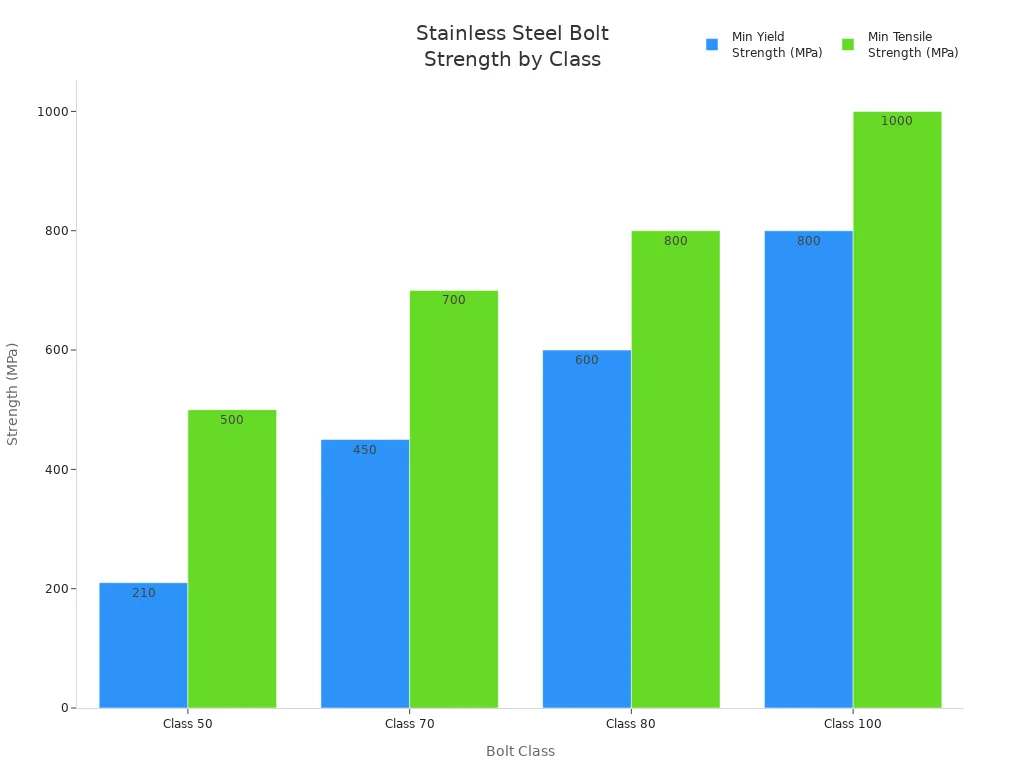
When you compare steel bolts, look at some main things. Carbon steel bolts are very strong and hard. If you add more carbon, they get even stronger. But, they do not fight rust well unless coated. Stainless steel fasteners are much better against rust. They also bend more easily. This makes them good for wet or chemical places. Stainless steel bolts are strong, but not always as strong as carbon steel. Cutting and welding stainless steel is harder.
Property | Carbon Steel Bolts | Stainless Steel Bolts |
|---|---|---|
Chemical Composition | Iron with varying carbon content (0.05%-1.5%) | Iron with ≥10.5% chromium, often with nickel and others |
Corrosion Resistance | Poor; prone to rust without coatings | Excellent; highly rust-resistant due to chromium content |
Tensile Strength (MPa) | Varies with carbon content (~300-900) | Moderate to high (~520-790 depending on grade) |
Yield Strength (MPa) | Generally high, increases with carbon | Lower than carbon steel but varies by stainless grade |
Ductility (%) | Decreases as carbon content increases (5-30%) | Generally higher, especially in austenitic types (up to 60%) |
Hardness (Brinell) | Increases with carbon content (100-250+) | Moderate to high depending on type (150-250+) |
Machinability | Easier to machine | More difficult to machine |
Weldability | Easier to weld | More difficult, requires specialized techniques |
Cost | Typically cheaper | More expensive |
Tip: Use stainless steel fasteners for wet or chemical places. They do not rust easily. For dry places that need strong bolts, carbon steel bolts are a good pick.
Strength is very important when picking bolts. Carbon steel bolts are very strong and last a long time. They work well for big jobs like building and cars. You can trust them for machines and heavy work. Stainless steel fasteners are strong too, but not as strong as the best carbon steel bolts.
Bolt Grade | Material Type | Tensile Strength Range |
|---|---|---|
Grade 2 | Carbon Steel | 60,000 to 74,000 psi |
Grade 5 | Carbon Steel | 105,000 to 120,000 psi |
Grade 8 | Carbon Steel | Up to 150,000 psi |
ASTM F593 | Stainless Steel | Standard referenced, no explicit tensile strength given |
Carbon steel bolts follow ASTM rules for strength. Grades like A307, A325, and A490 are very strong. Their strength goes from 60,000 psi up to 150,000 psi. Stainless steel fasteners follow ASTM F593. They focus more on fighting rust and looking nice than being super strong. Pick carbon steel bolts if you need the most strength and toughness.
Note: Stainless steel bolts are good for medium loads. Carbon steel fasteners are better for high strength and tough jobs.
Corrosion resistance is important in wet or salty places. Stainless steel fasteners are great here because of chromium and nickel. You can use them in boats, chemical plants, and food factories. They do not rust easily. Carbon steel bolts rust fast unless you cover them with special coatings.
Feature/Aspect | Carbon Steel Bolts | Stainless Steel Bolts |
|---|---|---|
Corrosion Susceptibility | Prone to rust and corrosion | Inherently corrosion resistant |
Common Coatings/Treatments | Zinc plating, galvanization, chemical plating, browning, phosphating, electroplating | None needed for corrosion resistance |
Effect of Damage on Protection | Coatings can be compromised if scratched | Maintains corrosion resistance even if scratched |
Suitable Environments | Dry or less corrosive environments | Corrosive environments (saltwater, chemicals) |
Maintenance | Requires maintenance to preserve coatings | Requires less maintenance |
Cost | Generally less expensive | More expensive |
Typical Applications | High volume machine parts, dry environments | Marine, chemical, medical, hydraulic |
Tests show carbon steel bolts rust all over in salty air. Even with coatings, they can fail if scratched. Stainless steel bolts do not rust, but can get small pits or cracks in places with lots of salt.
Tip: For anti-rust needs, stainless steel fasteners are best. Carbon steel bolts need coatings and care to stop rust.
Cost matters a lot when choosing bolts. Carbon steel bolts cost less than stainless steel fasteners. You save money at first with carbon steel, especially for big dry projects. Stainless steel bolts cost more because of their material and how they are made.
Carbon steel bolts are cheap for big jobs.
Stainless steel bolts cost more at first but need less fixing later.
In tough places, stainless steel fasteners last longer and save money over time.
A study showed stainless steel bolts lasted over 10 years, not just 2. Labor costs went down by more than half. Even though stainless steel bolts cost about 40% more at first, they were 25% cheaper over 15 years.
If you have little money and a dry place, pick carbon steel bolts. For saving money over many years in tough places, use stainless steel fasteners.
How long bolts last depends on what they are made of and where they are used. Carbon steel bolts can last up to 30 years in dry places, especially with zinc plating. But outside, they start to rust after a few years. Rust gets worse over time. Stainless steel bolts, like 300 series, last over 50 years outside. They do not rust, even in salty air.
Carbon steel bolts get surface rust after 6 years outside.
Stainless steel bolts look good and work for many years.
Stainless steel bolts can crack in salty or wet places.
Hot and cold temperatures also change how long bolts last. Carbon steel bolts get brittle below -50°C. Stainless steel bolts stay tough down to -120°C. At high heat, stainless steel bolts lose strength above 100°C. Carbon steel bolts start to weaken around 200°C.
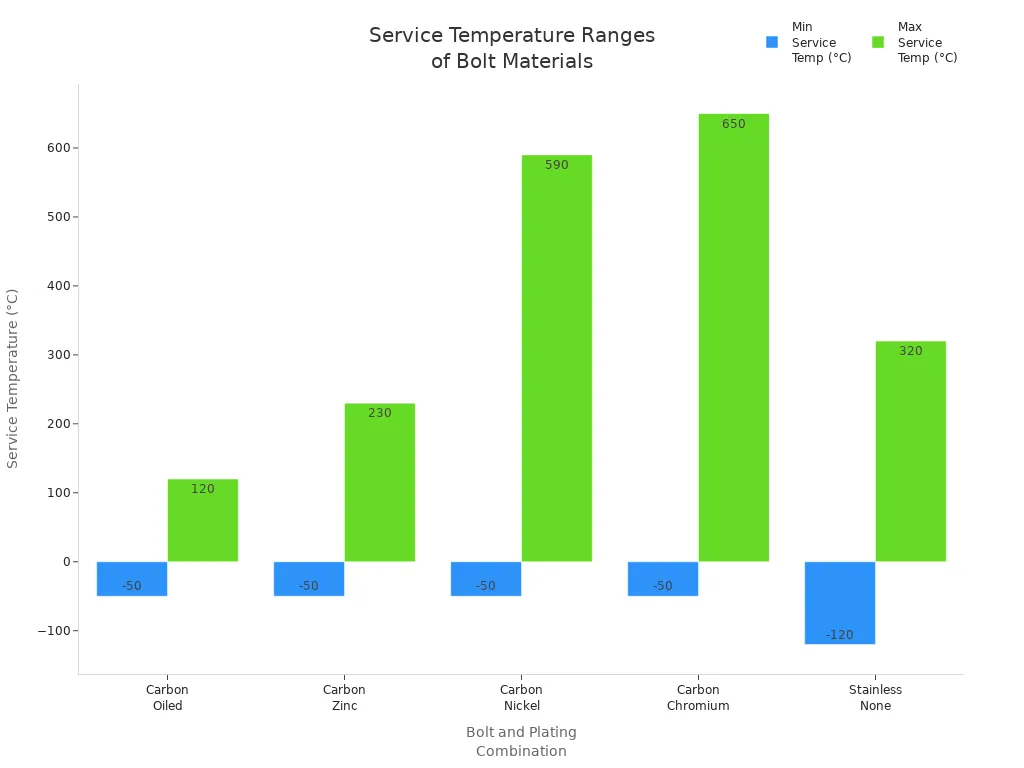
Pick stainless steel bolts for outside, near water, or in chemical places where you need them to last.
Both types of bolts can have problems when you put them in. Carbon steel bolts can cause galvanic corrosion if used with stainless steel parts and water is present. This happens because the metals are different. To stop this, use special gaskets or materials between them.
Stainless steel bolts can stick or seize when you put them in. Heat and rubbing can break the protective layer on the threads. This makes the metal stick and the threads can get damaged. This happens more if you use the same grade for both bolt and nut. You can stop this by using oil, mixing grades, and turning nuts slowly.
Carbon steel bolts almost never stick like this.
Stainless steel bolts need careful work to avoid thread damage.
Always use the right tools, washers, and oil for stainless steel fasteners.
Galling is a big problem for stainless steel bolts. Carbon steel bolts are easier to put in and do not stick as much.
Feature | Carbon Steel Bolts | Stainless Steel Bolts |
|---|---|---|
Strength | High strength, durable | Moderate to high strength |
Corrosion Resistance | Low, needs coatings | Excellent, inherent |
Cost | Lower initial cost | Higher initial cost |
Durability | Up to 30 years (dry) | Over 50 years (outdoor) |
Hardness | Increases with carbon | Moderate to high |
Installation Issues | Galvanic corrosion risk | Galling, thread seizure risk |
Maintenance | Frequent in harsh settings | Minimal in harsh settings |
Advantages | Cost-effective, strong | Corrosion resistant, long-lasting |
Disadvantages | Prone to rust, needs coatings | Galling risk, higher cost |
Think about what your project needs most. Carbon steel is strong and cheap but rusts. Stainless steel lasts long and does not rust, but can be hard to install.
Pick the bolt material based on where you will use it. The place you use bolts matters a lot. If you work inside or in dry air, carbon steel bolts are a good choice. These bolts are strong and cost less. But they can rust if they get wet. If your project is near water, chemicals, or salt, stainless steel fasteners are better. Grades like 304 and 316 do not rust in wet or salty places. For jobs near the ocean, 316 stainless steel is best. It has molybdenum, which helps fight saltwater. Galvanized carbon steel bolts can work outside for a short time. But they do not last long in wet or chemical places.
Use carbon steel bolts for dry, indoor places.
Use stainless steel bolts for wet or chemical places.
Pick 316 stainless steel for saltwater or ocean jobs.
Galvanized carbon steel bolts protect for a short time but need checks.
Tip: If you mix carbon steel and stainless steel bolts, rust can happen fast. Use special covers or coatings to stop this.
Strength is important when you pick bolts for heavy jobs. Carbon steel bolts, like Grade 8, are the strongest. They work for big machines, bridges, and tough jobs. You can see how strong they are in the table below:
Bolt Grade | Material Type | Proof Load (PSI) | Tensile Strength (PSI) | Example Load Capacity (lbs) for Diameter |
|---|---|---|---|---|
Grade 2 | Low Carbon Steel | Up to 55,000 (≤ 3/4") | Min 74,000 | 3/4" - 1 1/2" proof load 33,000 |
Grade 5 | Medium Carbon Steel | Up to 85,000 (≤ 1") | Min 105,000 | 1" - 1 1/2" proof load 74,000 |
Grade 8 | Medium Carbon Alloy Steel | Up to 120,000 (≤ 1 1/2") | Min 150,000 | 1/4" = ~7,350 lbs; 3/8" = ~16,500 lbs; 1/2" = ~29,400 lbs; 3/4" = ~66,200 lbs; 1" = ~117,800 lbs |
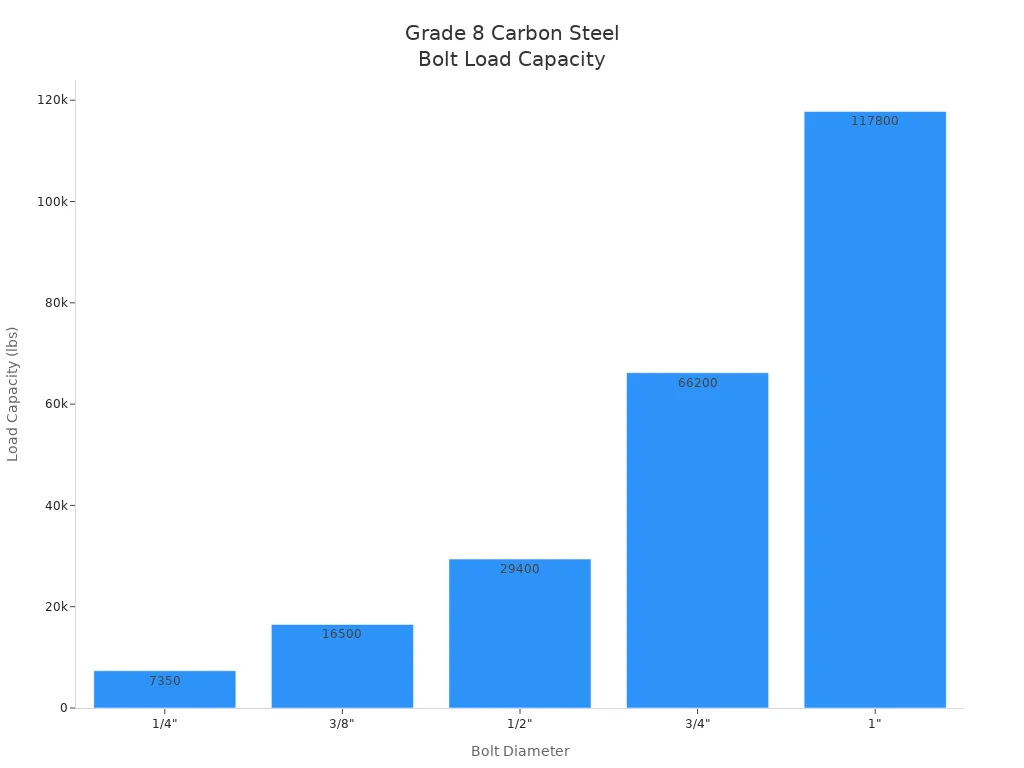
Stainless steel bolts are strong and do not rust, but they are not as strong as high-grade carbon steel bolts. Use stainless steel bolts when you care more about rust than strength. Always check the safety margin for your job. For important jobs, use a safety factor of at least 4 to keep things safe.
Note: Do not mix carbon steel and stainless steel bolts for heavy jobs unless you separate them. Rust can make the joint weak and unsafe.
How much money you have helps you pick bolts. Carbon steel bolts cost less and work well for big jobs inside or in dry places. They are strong and cheap, so they are good for building, machines, and indoor use. Stainless steel bolts cost more because of their special metals and how they are made. Their price can change if nickel or chromium prices go up or down. If you want to save money, use carbon steel bolts when rust is not a big problem. In tough places, stainless steel bolts can save money later because you do not need to fix or replace them as much.
Carbon steel bolts are best for small budgets and dry, indoor places.
Stainless steel bolts cost more but need less fixing outside or in wet places.
Stainless steel prices can change, so plan your money carefully.
If you want to save money and get good bolts, use carbon steel bolts with coatings in easy places. For saving money over many years in hard places, pick stainless steel.
How much you need to check and fix bolts depends on what you pick and where you use them. Carbon steel bolts need lots of checks and fixing, especially if they get wet. You must look at the coatings, paint or coat them again, and change rusty bolts to keep things safe. Stainless steel fasteners need less fixing. They do not rust, so you spend less time and money on them. In places with lots of water or chemicals, you should still check for small pits or cracks, but this does not happen much if you use the right grade.
Carbon steel bolts need lots of checks and fixing in wet or outside places.
Stainless steel bolts need little fixing, even in tough places.
Always look for rust, especially if you use both types of bolts together.
Checking bolts often helps them last longer and keeps your things safe.
Different jobs use different bolts based on what they need. In 2025, stainless steel bolts are used most in places where rust protection and strength matter. You see these bolts in big machines, roads, green energy, cars, planes, ships, oil and gas, water cleaning, and power plants. These jobs need bolts that do not rust and are strong.
Industry Sector | Preference for Bolt Type | Reason/Notes |
|---|---|---|
Heavy Machinery | Stainless Steel (304 grade) | High corrosion resistance and tensile strength required |
Infrastructure | Stainless Steel (304 grade) | Environmental mandates and modernization initiatives |
Renewable Energy | Stainless Steel (304 grade) | Offshore wind and solar farms need resilience in extreme environments |
Automotive | Stainless Steel (304 grade) | Lightweight design and durability for automated assembly |
Aerospace | Stainless Steel (304 grade) | High durability and corrosion resistance |
Marine | Stainless Steel (304 grade) | Corrosion resistance in marine environments |
Oil and Gas | Stainless Steel (304 grade) | Corrosion resistance and tensile strength |
Water Treatment | Stainless Steel (304 grade) | Non-reactivity and corrosion resistance |
Transport | Stainless Steel (304 grade) | Sustainability and modernization focus |
Energy Infrastructure | Stainless Steel (304 grade) | Environmental mandates and corrosion protection |
Construction | Stainless Steel (304 grade) | Key application area, but carbon steel usage not explicitly detailed |
Building jobs may use both types, depending on where and how strong the bolts need to be. For dry, inside, or easy jobs, carbon steel bolts are popular because they are cheap and strong. For outside, wet, or chemical places, stainless steel bolts are the main choice.
Always pick bolts that match your job’s safety, strength, and rust needs.
If you use carbon steel and stainless steel bolts together, rust can happen fast. This happens when water helps the metals react, making carbon steel rust quicker. You can stop this by using nylon washers, pipe shoes, or other covers to keep the metals apart. Galvanized coatings on carbon steel bolts help for a short time, but not forever. For important connections, use the same kind of bolts everywhere to stop fast rust and keep things safe.
Mixing metals can make rust happen up to five times faster. Always check if bolts work together and use covers or coatings to keep your bolts safe.
In 2025, new ways to use fasteners are coming. Many jobs now need bolts that are stronger and fight rust better. Stainless steel fasteners are used a lot in planes, cars, and green energy. These jobs want bolts that are light, strong, and do not rust. More companies use coatings that are good for the earth and recycled stuff. Makers use smart tools like AI and IoT to put sensors in fasteners. These sensors help you watch how bolts work and know when to fix them. Companies now want supply chains that are strong and close to home. Money from the government and green rules make more people use bolts in bridges, trains, and smart power.
New buildings and green energy need stronger fasteners.
Stainless steel fasteners with sensors help you fix things before they break.
Using green coatings and recycled stuff helps the planet.
Smart fasteners are used more in important jobs.
You can learn from real jobs. In one job near the sea, workers used carbon steel bolts in salty dirt. These bolts rusted fast and got weak. The team changed to stainless steel fasteners and put on special coatings. This stopped rust and made the building last longer. Jobs near the sea or with chemicals now use stainless steel fasteners to stop problems. These stories show picking the right bolt keeps your stuff safe for a long time.
You can save money by not making these mistakes:
Leaving bolts open to dirt or water, which makes them rust.
Picking the wrong stainless steel grade, like not using 316 in tough places.
Using stainless steel with little nickel, which rusts near the sea.
Not putting bolts in right, which breaks their protection.
Picking cheap bolts instead of good ones, which can break.
Mixing different metals, which makes rust happen faster.
Using the wrong force, which can break or loosen bolts.
Not thinking about how strong bolts need to be or where they will go.
Tip: Always pick the right bolt grade for your job and place. This helps bolts last longer and saves you work later.
You need to match your bolt choice to your project’s needs. Carbon steel bolts give you high strength and lower cost, but they need coatings and more maintenance. Stainless steel bolts resist rust, last longer outdoors, and need less upkeep, though they cost more. Use the table below to guide your decision:
Factor | Carbon Steel Bolts | Stainless Steel Bolts |
|---|---|---|
Strength | High | Moderate |
Corrosion Resistance | Low | High |
Cost | Lower | Higher |
Maintenance | Frequent | Minimal |
Best Use | Dry, high-stress jobs | Wet, outdoor, chemical |
Choose bolts that fit your environment, load, and budget. For tailored solutions or bulk orders, contact our team today to discuss your project needs.
Carbon steel bolts are strong and cost less. Stainless steel bolts do not rust and last longer outside. Pick the bolt that fits your project’s place and how long you need it to last.
You can use carbon steel bolts outside if you cover them. These bolts can rust fast in wet or salty places. Stainless steel bolts are better for outside jobs.
Stainless steel bolts can stick because rubbing breaks their shield. You can stop this by using oil, mixing bolt types, or turning nuts slowly.
Carbon steel bolts are usually stronger, especially for big jobs. Stainless steel bolts are strong enough and do not rust. Pick the bolt that matches how much weight you need to hold.
You can stop galvanic corrosion by using plastic washers or sleeves. Always keep carbon steel and stainless steel bolts apart in wet places to keep things safe.